The International Union of Biological Sciences (IUBS) was established in 1919 as a non- governmental and non-profit organization comprising of National Academies and international scientific Associations and Societies. Since then IUBS is functioning as a global platform of scientists from all disciplines and nationalities for cooperation, interaction and collaboration to promote research, training, and education in biological sciences.
To commemorate completion of 100 years of promoting excellence in biological sciences, IUBS has launched a Webinar Series bringing the best of all disciplines to discuss evolution, taxonomy, ecology, biodiversity, and other topics that represent unified biology and the topics of prime importance to address contemporary problems such as climate change, endangered species, food and nutrition, health etc.
The first lecture of the webinar series was delivered by Rattan Lal, 2020 World Food Prize Laureate on “Forgetting How to Tend the Soil” on 2nd October 2020. The second lecture of the series “The Serengeti Rules: The Regulation and Restoration of Biodiversity” on 10th March 2021 was delivered by an award-winning biologist, educator, film producer, author and science communicator, Sean B. Carroll. The third lecture in the IUBS Webinar Series was delivered by Dr. Jane Goodall, DBE on “Gombe and Beyond”. The fourth lecture was from Yvon Le Maho on “New technology to investigate Antarctic penguins without disturbance“.
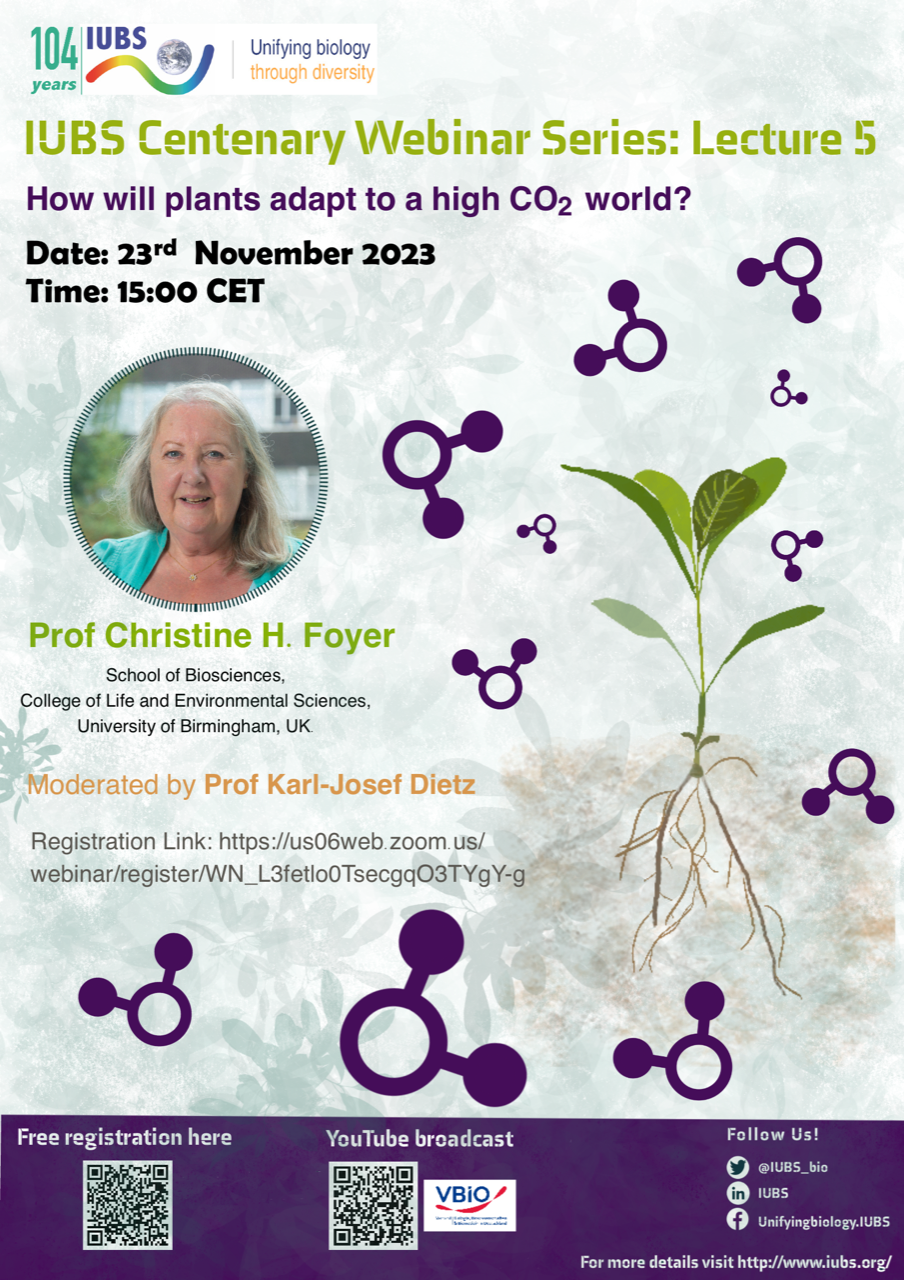
The fifth lecture of the Webinar Series will be delivered by Christine H. Foyer, Scchoolof Biosciences, College of Life and Environmental Sciences, University of Birmingham, UK, on
“How will plants adapt to high CO2 world?”
Moderated by Karl-Josef Dietz, Bielefeld University, Germany



About the Speaker
Christine Foyer is Professor of Plant Sciences at the University of Birmingham. She is a Member of the Environmental Sustainability Board of the FERRERO group, a Member of the French Academy of Agriculture and the Editor in Chief of Food and Energy Security. In 2022, she held the Janaki Ammal Chair of the Indian Academy of Sciences, she was made an International Fellow of the Indian Society of Plant Physiology and she received the Charles F. Kettering Award of the American Society of Plant Physiology. Christine has over 450 published papers and ranked as a Highly Cited Researcher™ list from Clarivate™. She is placed 4th in the list of the world’s Best Scientists in Plant Sciences,
(https://research.com/scientists-rankings/plant-science-and-agronomy) and is ranked 21 in United Kingdom and 219 in the world in the 2022 Edition of the Research.com Ranking of Top 1000 Female Scientists in the World. Christine is an expert in plant metabolism and its regulation under optimal and stress conditions. Her lab focuses on the role of reduction/oxidation (redox) processes and signals regulate plant growth and stress tolerance, studying how primary processes (photosynthesis respiration) alter the redox status of cells and associated phytohormone signalling under optimal and stress conditions. Using model (Arabidopsis) as well as crop plants (wheat, barley, maize soybean and tomato) the lab investigates plant responses to abiotic (drought, heat, chilling, high light) and biotic (aphids) stresses.
About the Lecture
Climate change is the defining issue of our generation. In this presentation, I will introduce the topic of climate change, the greenhouse effect and greenhouse gases, covering photosynthesis and its importance in ecosystems, particularly in relation to the carbon dioxide fertilisation effect and nature-based solutions to climate change. I will discuss how scientists measure the impact of high atmospheric carbon dioxide concentrations in crops and forests using Free-Air Carbon dioxide Enrichment (FACE) sites. I will use two examples: the FACE site in Urbana USA that focusses on crops and the Birmingham Institute for Forest Research (BIFoR) FACE site that studies how forest ecosystems will respond to future increases in atmospheric carbon dioxide. I will discuss some of the results obtained to date and their implications for society and the UK roadmap to net zero.